

Reject Fake Muse
The False Voices That Steal Our Creativity

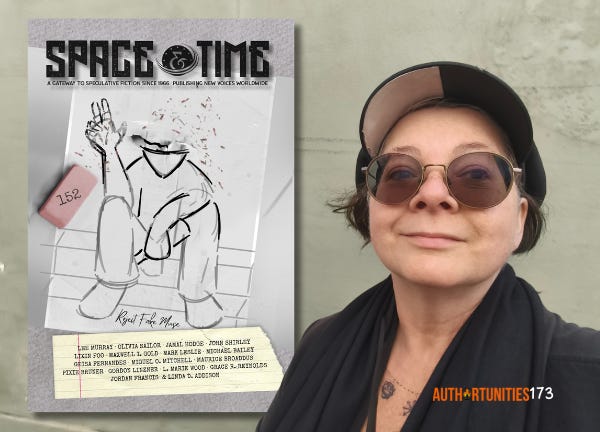
The beginning of July means we have a new theme: Reject Fake Muse. Today we are naming the false voices that pull us away from our work and call it wisdom, safety, or care. In other news, Space & Time No. 153 is on pre-order and submissions are open for the September issue.
I was in second grade when I met my first fake muse.
It was Career Day, and the assignment was simple: draw a picture of what you wanted to be when you grew up. I already knew. I grabbed a crayon and drew a woman in an ankle-length dress. She carried an oversized pencil like a battering ram. Underneath it I wrote “writer.”
Next to me, my friend Dixon drew an astronaut. We congratulated each other on our excellent career choices. Then Mrs. Cole came up behind us.
“Astronaut. Very nice, Dixon,” she said. Then she looked at my drawing.
“Angie, pick something else. You don’t want to be a writer. Writers starve and it isn’t a real job. Draw something else or take a C.”
I took the C.
I knew she was wrong. I didn’t have the language for it yet, but I understood something important: warning us away from our dreams is fear masquerading as wisdom. Fake muses aren’t always trying to crush hope. Sometimes they are only repeating the limits that were handed to them, the limits they swallowed until those limits felt like truth. In their subconscious, somewhere, is a bitter acceptance of reality as a compromise between what they want and what they had to settle for.
That is how a fake muse begins.
A fake muse rarely arrives looking false. It doesn’t kick down the door with horns, smoke, and a pitchfork. It usually sounds concerned, practical… protective, even. It tells us to be realistic. It tells us not to strive too hard. It tells us to put the work down for one more night, then another, then another. It tells us we are too tired, too busy, too late, too old, too young, too broken, too ordinary, too much, not enough. It tells us gilded lies.
The fake muse is not inspiration. It’s interruption dressed as guidance and depletion disguised as devotion. It’s the voice that separates us from our own voice and then praises us for being restrained.
This July, the theme for Space & Time is Reject Fake Muse, anchored by Kyra Starr’s cover inspired by The Devil card in tarot. The Devil is not simply a symbol of evil. It is bondage. Obsession. Unhealthy attachment. Shame. Manipulation. The trap we can see clearly from the outside but struggle to name once we are standing inside it.
The face on the cover is left unfinished because the viewer is meant to complete it. We all see a different devil. We all have a different fake muse.
For some of us, the fake muse is distraction. The endless doom scroll, the outrage cycle, the perceived emergency. It’s the shiny new idea that appears every time an old one needs to be finished. It’s that research rabbit hole that feels productive while the actual page remains blank.
For some of us, the fake muse is approval. We begin measuring our worth by applause, numbers, reviews, invitations, comments, and the likes of strangers. We tell ourselves we are “building community” when we are really obsessively refreshing to see if we still have permission to be here.
For some of us, the fake muse is perfectionism. It promises excellence but delivers paralysis. It tells us that we are protecting the integrity of our work with our patient delays. It tells us the next draft will finally make us safe from criticism, misunderstanding, rejection, mockery, or indifference.
For some of us, the fake muse is another person’s voice that moved in so long ago we start believing it’s our own.
The purpose of naming the fake muse is not to stay trapped in the story. The purpose is to see it for what it is. Recognition is the first break in the chain.
A real muse challenges us. She might wake us at inconvenient hours. She will ask us to be brave, disciplined, honest, and devoted to our vision. She can challenge us to tell the truth before we feel ready. She doesn’t isolate us from what inspires us. She doesn’t make us feel guilty for having boundaries.
The real muse asks us to be ourselves.
The fake muse tells us to be someone else.
This is why the fake muse can be so sneaky. It’s attracted to the restless dissatisfaction that nudges us to make something. It addresses the ache and offers us something easier than the blank page. The fake muse is a snake-oil seller of solutions. It offers us drama instead of discipline, novelty instead of completion, applause instead of purpose, numbness instead of rest. For a while, that feels good.
It’s never too late to reclaim our creativity. That is the hopeful part. The fake muse can distract us, but it can’t own us. The chain may be real, but so is the key.
So this month, I am asking us to look directly at the unfinished face on the cover and complete it honestly. Name your fake muse. List the lies it has told you.
Mrs. Cole told me writers starve. She was wrong. Not writing is what starved me.
This July, we reject our counterfeit muses. We stop handing our pens to fear, distraction, guilt, perfectionism, false urgency, and other people’s unfinished devils.
We name the thing that has been feeding on us. We pick up our pens.
We reject our fake muse.
This Week in the Ecosystem
📅 · The Authortunities Calendar has been updated.
📢· Space & Time Magazine/Authortunities Press has been approved for fiscal sponsorship through Fractured Atlas, a nonprofit arts service organization. This opens the door for grant support and future tax-deductible giving toward our literary arts work. We are deeply grateful for this next step and excited for what it makes possible.
🔥 · Pre-order Space & Time 152 in ebook, standard print, large print, or dyslexia-friendly print.
🎙️· This week on Reading Space & Time, we begin sharing the stories and poems from our July issue, featuring “Milking” by Lee Murray, “Ever Changing Landscape” by Olivia Sailor, “Caution When Hunting Unicorns” by Jamal Hodge, and “A Ravenous Cloud” by John Shirley.
The idea that it's more achieveable to be an astronaut than a writer XD
RE: "false voice" - - At 9 years old, I had my first one-act play onstage in NYC. Though performances ran for months, my parents did not attend. (My "stay at home Mom" had no workplace to go to.) The "false voice" whispered, "See! Your family doesn't care. Your family is not impressed. Why not do something that would impress them?" However, every seat was taken. Strangers applauded. The lesson I took from this experience, an elementary schoolgirl, was that a young dramatist needed more than an audience of TWO. Which would I have preferred: only Mom & Dad in the audience - - - or an auditorium of New Yorkers? 🎭 I can still hear my first ovation! 🎭 👏