

Protect Your Lightning
Staying with the work in an age of endless distraction

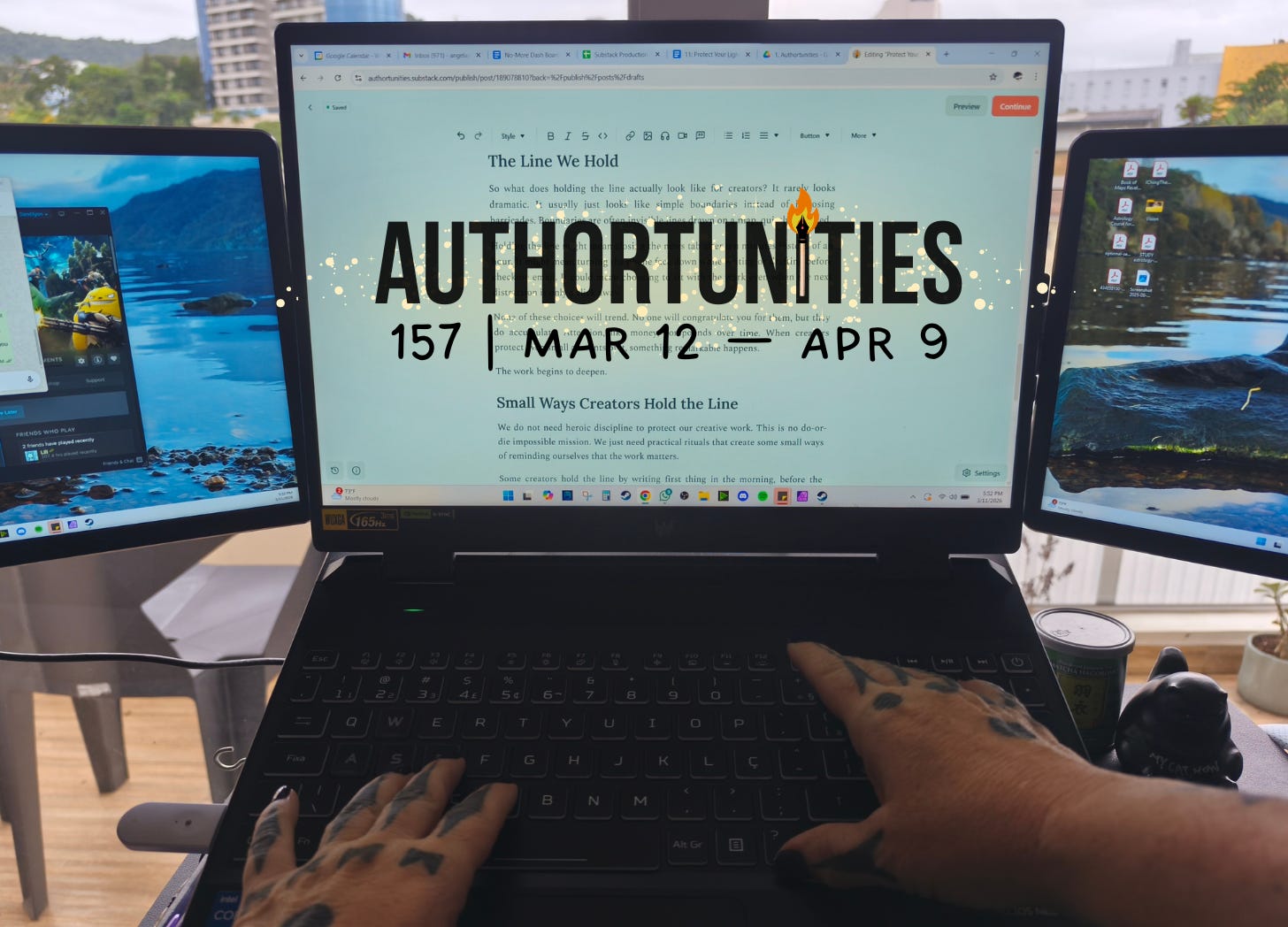
The lightning strikes. The pen starts moving. Then the phone pings.
Ten minutes later you’re lost in a different drama, one that contributes nothing to the story you were trying to create on paper. These interruptions aren’t always accidental. Often, they’re designed.
Last week we talked about holding the line and the commitment creators make to continue building meaning in a world that often values speed and spectacle more than depth. This week we’re exploring something that makes holding the line harder than it has ever been before.
Attention.
Right now, nearly everything around us is designed to pull it away.
Notifications blink. Buy this!
Algorithms whisper. Click that!
Headlines demand urgency. Share this outrage!
Stay informed-relevant-updated… stay alive and clicking.
There is nothing inherently wrong with any of these things. Humans have always shared information and gathered around stories about what is happening in the world, but something has changed in the scale and intensity of the demand.
Our attention has become a commodity and entire industries now exist to capture and hold human attention for as long as possible. They are harvesting our free time like farms harvest crops. Some might argue that isn’t a big deal. Free time is free, right?
Wrong. Free time is our creative time.
The Creator’s Attention
As my Southern Grandma used to say, “You can’t rush genius cookin’.” To create something meaningful requires a particular kind of attention. It is slower and quieter.
Writers sit with sentences that refuse to cooperate. Artists stare at canvases that are not yet right. Musicians play the same notes again and again until they develop into a tune.
This kind of attention is not profitable for platforms. It’s not easily monetized or measured but it is the soil from which meaningful work grows.
And it is increasingly under siege.
Informed vs. Consumed
I’m not suggesting we isolate ourselves. Creators do need to stay informed. We live in the world we write about. We respond to culture, politics, history, and human experience. Awareness matters.
But there is a difference between being informed and being consumed. Being informed means intentionally learning what we need to understand the world. Being consumed means drifting endlessly through information that rarely deepens our understanding but constantly drains our focus.
One is intentional.
The other is gravitational.
Like quicksand, it will pull our attention downward into the endless scroll until our creativity suffocates.
The Line We Hold
So what does holding the line actually look like for creators? It rarely looks dramatic. It usually just looks like simple boundaries instead of imposing barricades. Boundaries are often invisible lines drawn on a map, quietly enforced.
Holding the line might mean closing the news tab after ten minutes instead of an hour. It might mean turning the phone face down while writing or drafting before checking email. It could mean choosing to sit with the work even when the next distraction is only a click away.
None of these choices will trend. No one will congratulate you for them, but they do accumulate. Attention, like money, compounds over time. When creators protect even small amounts of it, something remarkable happens.
The work begins to deepen.
Small Ways Creators Hold the Line
We do not need heroic discipline to protect our creative work. This is no do-or-die impossible mission. We just need practical rituals that create some small ways of reminding ourselves that the work matters.
Some creators hold the line by writing first thing in the morning, before the world has time to interrupt. Others set aside a protected hour each day where nothing but the work is allowed to exist. Some keep notebooks nearby so ideas are captured before the internet captures them instead. Others build environments and routines that encourage focus.
The exact method matters less than the commitment behind it. Every time we choose the work over the scroll, we strengthen that commitment.
This Work Matters
In a world built to fragment attention, sustained creativity becomes a quiet act of resistance. Not loud resistance and performative resistance. Just the steady insistence that making something meaningful is worth protecting.
Every page written. Every sketch completed. Every melody refined. These are the small signals that the creative spirit is still alive and still working and those signals travel farther than we often realize.
Someone will read the words. Someone will hear the song. Someone will encounter the idea and feel like a them-sized door has been left open.
Holding the Line
The line we hold as creators is not dramatic. It is simply the choice to return to the work again and again. We close the browser, silence the notification, sit down and continue building something that did not exist before. This is how creators keep the signal lit, one quiet session at a time.
We hold the line by staying with the work long enough for the lightning to return.
This Week in the Ecosystem
🔥Your Authortunities Calendar is updated weekly and available here.
➡️Beginning in April, Authortunities membership will be $10/month starting April 1 to support Space & Time’s transition from biannual to monthly publication and the sustained editorial infrastructure behind it. Members will receive the monthly digital issues of Space & Time along with full access to the Authortunities ecosystem.
Membership includes:
• Weekly essays
• Monthly digital Space & Time issues
• Access to Space & Time’s digital archives
• Members-only office hours
Current paid members are locked in at their existing rate.
Brilliant! Intentional vs. gravitational. I’m working so hard to protect my spark. And something must be working because I saved this aside to read in my own time. And here I am a week later. 💕
I love this. It is so important. I get an idea for something and title a placeholder title document in a file on my computer. Then, whenever I have a snippet of it as I'm in the forming process, I type it in...no matter where in the poem, prose, or FF it is. I don't try to make it into anything other than the line or lines that they are wherever they fit in. Then, when I sit down to work on it after about a week, I have a patchwork formed. They aren't lost because I didn't try to fit a story or form around them yet. I also tend to work late at night until early morning. The world is very quiet.